
The 7 Best No-Pull Dog Harnesses of 2026 (Compared, Reviewed, Honest Picks)
How we choose our picks: I don’t pretend to lab-test every harness in a warehouse. These rankings come from comparing the specs side by side, reading through hundreds of verified buyer reviews for the patterns that keep coming up, and leaning on what trainers and vets actually recommend. When I flag a flaw, it’s because real owners kept hitting it — not because a brand paid for a spot. Nobody can buy their way onto this list.

2 Hounds Design Freedom Harness
Our #1 recommendation after research and real-world comparison. Best balance of quality, performance, and value.

Vaccines, medications, vet visits, weight, feeding, a symptom diary and pet-sitter sheets, in one 44-page fillable planner you can type into or print.
Get The Dog Owner’s Planner · $9.99 on Etsy →Quick picks
If you’re short on time, here’s the bottom line. Each link below is an affiliate link — using them costs you nothing extra and helps support honest reviews like this one.
- Best overall: 2 Hounds Design Freedom No-Pull Harness (direct, or on Amazon) — the harness most professional trainers actually recommend.
- Best budget: Rabbitgoo Front-Clip Harness — under $25, surprisingly durable.
- Best for strong pullers: Ruffwear Front Range — what mountain rescue handlers use.
- Best for tiny dogs: Puppia Soft Harness — gentle on tracheas, no chafing.
- Best for big dogs: Blue-9 Balance Harness — dual-clip, escape-proof, fully adjustable.
- Best escape-proof: Ruffwear Web Master — a third strap behind the ribs makes this harness houdini-proof.
- Best for service & training work: Julius-K9 IDC Powerharness — modular, tactical, indestructible.
Updated November 3, 2026: every link and stock status re-checked.
Side-by-side comparison
| Harness | Who it’s for | Leash clips | Typical price |
|---|---|---|---|
| 2 Hounds Design Freedom also on Amazon | Medium and large dogs that pull | Front + back | $40–$55 |
| Rabbitgoo Front-Clip | Tight budgets, a spare harness | Front + back | $20–$28 |
| Ruffwear Front Range | Big, strong pullers, hiking | Front + back | $50–$60 |
| Puppia Soft | Toy breeds under about 15 lb | Back only | $18–$28 |
| Blue-9 Balance | Large and deep-chested dogs | Front + back | $45–$55 |
| Ruffwear Web Master | Escape artists, newly adopted rescues | Back only | $65–$75 |
| Julius-K9 IDC Powerharness | Working and sport dogs | Back only | $60–$80 |
Front + back means you can clip at the chest to redirect pulling and move to the back clip as the dog improves. Back-only harnesses are comfortable, but on their own they don’t discourage pulling.
Why no-pull harnesses actually work (and why most “no-pull” products don’t)
A no-pull harness isn’t magic — it’s geometry. Standard back-clip harnesses give your dog perfect leverage to pull forward, the way sled dogs are designed to. Front-clip harnesses redirect that pulling force sideways, which gently turns the dog back toward you. The result: pulling becomes pointless, and your dog quickly learns to walk on a slack leash.
The catch: a front-clip harness only works if it fits correctly. Too loose and the chest piece rotates and rubs. Too tight and you’ll restrict shoulder movement (which is actually unsafe long-term). Most one-star Amazon reviews of no-pull harnesses are really fit problems in disguise.
I’ll cover fit and proper use further down. First, the picks.
What I looked for
Every harness on this list was evaluated on:
- Pull control. Does the front clip actually redirect a 50–80 lb dog?
- Fit and adjustability. How many adjustment points? Will it fit a deep-chested breed (Greyhound) and a barrel-chested breed (Bulldog)?
- Comfort. Padded chest plate? Breathable mesh? Any chafing reports after 30+ minutes?
- Build quality. Buckle strength, stitching, hardware (steel D-rings vs plastic).
- Price-to-value. Are you paying for a brand, or for actual engineering?
- Real-world reviews. Patterns across 500+ verified reviews on Amazon, Chewy, and trainer forums.
I do not include harnesses I wouldn’t put on my own dog. Several “popular” Amazon brands didn’t make the cut because their construction is one wash cycle away from failure.
The 7 best no-pull dog harnesses, reviewed
1. 2 Hounds Design Freedom No-Pull Harness — Best Overall

Read the full review: 2 Hounds Design Freedom No-Pull Harness Review.
Price range: $40–$55
Best for: medium and large dogs, especially regular pullers
Sizes: XS through XXL
Check the price at 2 Hounds Design → | See on Amazon →
This is the harness most certified professional dog trainers (CPDTs) recommend, and it’s not a coincidence. The Freedom uses a martingale loop on the back: when your dog pulls forward, the loop tightens slightly across the chest, applying gentle pressure that interrupts pulling without choking. The front clip on the chest gives you the redirect option for stronger pullers.
What I love:
– Two clip points (front + back) means you can switch as your dog improves.
– Velvet-lined chest strap — almost no chafing reports from owners of short-coated dogs.
– Made in the USA, hand-stitched, durable hardware.
– 5-year manufacturer warranty.
Trade-offs:
– The martingale design takes 2–3 walks to learn how to fit properly. Watch their YouTube fit video.
– Pricier than Amazon imports, but the build quality is in a different category.
Skip if: your dog is under 15 lbs (the smallest size still slightly overshoots tiny dogs).
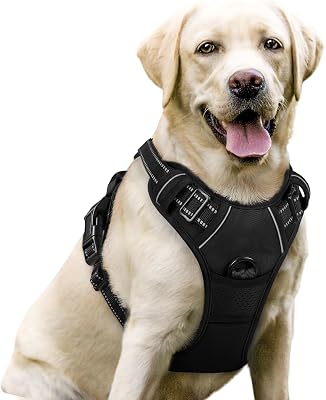
2. Rabbitgoo Front-Clip Harness — Best Budget
Price range: $20–$28
Best for: budget-conscious owners, dogs that grow out of harnesses, second harness for travel/backup
Sizes: XS through XXL
Check current price on Amazon →
If you can’t justify $50+ for a harness right now, this is the one to buy. Rabbitgoo isn’t fancy, but for the price it punches well above its weight. Two metal D-rings (front and back), four adjustment points, and reflective stitching. Plenty of owners run these on 60–80 lb dogs for years without the hardware giving out.
What I love:
– Genuinely good front-clip redirect for a sub-$25 product.
– Reflective trim is functional, not just decorative.
– Easy on/off with two side buckles — no need to lift legs.
Trade-offs:
– The padding compresses over time. Expect 12–18 months of life with daily use.
– Sizing runs slightly small. Measure twice.
– Plastic buckles, not metal. Fine for normal use, not for extreme pullers.
Skip if: your dog is a serious puller (60+ lb regularly lunging at squirrels). Get the Ruffwear instead.
Worth comparing at this price: the Joytale No-Pull Harness sits in the same bracket as the Rabbitgoo and solves the two complaints above — it has a padded control handle over the shoulders, which the Rabbitgoo lacks, and owners report the padding holding up better past the 12-month mark. It is a back-and-front-clip vest rather than a strap harness, so it spreads pressure more like the 2 Hounds does. Sizing runs true, unlike the Rabbitgoo. If your dog is a moderate rather than a serious puller, it is the closer call of the two.
Affiliate link. We earn a commission if you buy through it, at no extra cost to you. It does not affect the ranking above.
3. Ruffwear Front Range — Best for Strong Pullers

Price range: $50–$60
Best for: large breeds, serious pullers, hiking and active use
Sizes: XXS through XL
Ruffwear makes professional gear for working dogs and search-and-rescue teams. The Front Range is their everyday harness, and it’s the harness I’d reach for first with a big, strong dog. Two clip points, four adjustment straps, foam-padded chest panel, and a reinforced load-bearing handle on top (useful for lifting your dog over obstacles or into a car).
What I love:
– The chest plate distributes pulling force across a wide area — no pressure points.
– Owners run it through rain, river crossings, and years of hard trail use, and it holds up.
– The handle is genuinely useful, not a gimmick.
Trade-offs:
– Ruffwear’s sizing chart is conservative; many owners size up. Read the chart carefully.
– More expensive than budget options but the cost-per-year is lower because they last 4–6 years.
Skip if: you only walk your dog around the block twice a day. This is overkill for pure-suburban use.
4. Puppia Soft Harness — Best for Tiny Dogs

Price range: $18–$28
Best for: Chihuahuas, Yorkies, Pomeranians, Toy Poodles, Maltese
Sizes: XS through XL (but sizing skews small)
Tiny dogs have fragile tracheas. Pulling on a collar can cause genuine injury, and most “no-pull” harnesses are oversized for sub-15 lb dogs. The Puppia is a soft, vest-style harness made of breathable air-mesh, with a back clip and quick-release plastic buckle. It’s designed specifically for small breeds.
What I love:
– No-fuss step-in / pull-over design — toy dogs hate fussy gear.
– Genuinely comfortable for daily wear (some owners leave it on all day).
– Trachea-safe: pulling distributes across the chest, not the throat.
– Comes in many colors, holds up well in the wash.
Trade-offs:
– Back-clip only. For small dogs, that’s usually fine — they don’t generate enough pulling force to need a front clip.
– Not for chewers; the soft mesh isn’t tear-resistant.
Skip if: your tiny dog is a determined puller. Try the smaller size of the 2 Hounds Freedom instead.
The other small-dog option worth knowing about: the Joytale Step-In Mesh Harness is the same idea as the Puppia — soft, breathable, trachea-safe, back-clip — but it is a step-in rather than an over-the-head design, which matters a great deal if your dog objects to anything going over their face. It also carries reflective trim the Puppia does not. It has the same limitation: back-clip only, so it is for small dogs that do not seriously pull.
Affiliate link. We earn a commission if you buy through it, at no extra cost to you. It does not affect the ranking above.
5. Blue-9 Balance Harness — Best for Big Dogs

Price range: $45–$55
Best for: large/giant breeds, deep-chested dogs (Boxers, Vizslas, Dobermans)
Sizes: XS through XXL
Designed by a service dog trainer specifically for working with large dogs, the Balance has six adjustment points — three more than most competitors. That extra adjustability means you can dial in fit for breeds that don’t fit the “average dog” mold. The Y-shaped chest piece sits below the trachea and stays clear of the shoulder joint, so it doesn’t restrict gait.
What I love:
– The fit-tunability is unmatched. Owners of Greyhounds, Whippets, and other tricky-to-fit breeds rave about this.
– Wide, padded straps spread pressure across a larger area.
– Two clip points, escape-resistant when adjusted properly.
– Used in service-dog training programs nationwide.
Trade-offs:
– All those buckles take 3–4 walks to dial in. Watch the Blue-9 fit video twice.
– Heavier than minimal harnesses. Not ideal for small dogs.
Skip if: you want quick on/off in 5 seconds. The 2 Hounds is faster.
6. Ruffwear Web Master — Best Escape-Proof

Price range: $65–$75
Best for: rescues, anxious dogs, escape artists, dogs that “back out” of harnesses
Sizes: XXS through XL
If you’ve ever had a dog wriggle out of a normal harness mid-walk — usually in panic during fireworks, a thunderstorm, or a vet visit — you’ll understand why this exists. The Web Master adds a third strap that wraps around the dog’s belly, behind the ribcage. Combined with two front straps, it’s mathematically impossible for the dog to slip out without unbuckling.
What I love:
– Genuinely escape-proof. Recommended by rescue organizations for newly-adopted dogs whose temperament you don’t know yet.
– The handle on top is reinforced and load-rated — you can lift a 60 lb dog with it.
– Built to survive years of abuse.
Trade-offs:
– Three straps means more on-off time and more chafing risk if not fitted carefully.
– Premium price. Can’t dispute it though — these last 5+ years.
Skip if: your dog has never tried to escape and is already harness-trained. This is overkill for confident dogs.
7. Julius-K9 IDC Powerharness — Best for Working Dogs

Price range: $60–$80
Best for: police/military-style training, working breeds, search-and-rescue, IPO/Schutzhund sport dogs
Sizes: Mini-Mini through 4
This is what European working-dog handlers use. It’s not a no-pull harness in the traditional front-clip sense — instead, it’s a structurally-perfect harness that any dog can pull into without injury, with modular ID patches, water-bottle holders, and side bags. If you’re doing real training work (tracking, protection, agility), this is the only harness on the list designed for that.
What I love:
– Tank-like construction. Owners report theirs lasting the better part of a decade.
– The reflective edges and chest patch make it visible at night.
– The handle is reinforced for lifting and control.
– Modular Velcro patches let you customize for specific tasks.
Trade-offs:
– It’s a back-clip-only harness. If your goal is pure no-pull training, it’s not the right tool.
– The closed-loop step-in design is awkward for owners with mobility issues.
Skip if: you’re not doing training work. The Ruffwear Front Range will serve you better.
Deciding between the top three? The Freedom, the PetSafe Easy Walk and the Blue-9 Balance stop pulling by three genuinely different mechanisms, and the right one depends on your dog’s build and how long the harness stays on. We break the choice down side by side in Freedom vs. Easy Walk vs. Balance.
Shopping for someone else’s dog this year? Two harnesses from this list, the Freedom and the Rabbitgoo, are in our gifts for dog lovers guide, along with other picks under $25, $50 and $100.
How to fit a no-pull harness correctly
Bad fit is the #1 reason no-pull harnesses fail. A few rules:
- Two-finger rule. You should be able to slide two fingers (flat) under any strap. One finger = too tight; three = too loose.
- Chest plate sits on the breastbone, never on the throat. The Y-shape should hang below the dog’s “Adam’s apple.”
- The front D-ring should sit centered on the chest. Not off to one side. If it rotates, the harness is too loose.
- Back strap goes 3+ inches behind the front legs. Closer than that, you’ll get armpit chafing.
- Test the fit with a tug. Hold the leash, ask your dog to walk forward, give a gentle pull. The harness should turn the dog without binding.
If your dog has short or fine fur, watch for chafing in the first 2 weeks of wear. Wipe down the harness after rainy walks (wet straps cause more rubbing). And measure your dog both around the chest at the widest point and at the base of the neck — most sizing charts use both.
How to actually train your dog to walk on a loose leash
The harness is the tool. The training is what changes behavior. Here’s the 4-step protocol I use:
- Stop walking the moment leash tension hits the harness. Just stop. Stand still.
- Wait for slack. Your dog will turn back to look at you within 10–30 seconds.
- Mark and resume. When the leash goes slack, say “yes!” and walk again.
- Reward direction changes. Every 60 seconds during a walk, change direction without warning. Treat when your dog catches up.
Inside two weeks, most dogs walk on a slack leash 80% of the time. Inside a month, they’re matching your pace.
For dogs with severe pulling, I recommend pairing the harness with a structured training program. How to Stop a Dog From Barking at Night discusses one approach.
Common questions
Will a no-pull harness hurt my dog?
No, not when fitted correctly. The pressure is gentle and lateral — far less than a choke chain or prong collar. Front-clip harnesses are recommended by the American Veterinary Society of Animal Behavior as a safe, force-free tool.
Should I switch from a collar entirely?
For walks, yes. Keep a flat collar for ID tags, but attach the leash to the harness. This is especially important for brachycephalic (flat-faced) breeds like Frenchies and Pugs, who are prone to tracheal collapse from collar pressure.
At what age can I put a harness on my puppy?
8 weeks and up, as long as the harness fits. Don’t rely on size charts alone — measure. Puppies grow fast; expect to replace the harness twice in the first year.
Front-clip vs. back-clip — does it matter for a non-puller?
For dogs that already walk politely, back-clip is fine and more comfortable. Front-clip is specifically a training and management tool for dogs that pull.
Is the 2 Hounds Freedom No-Pull Harness worth it? (The short Freedom harness review)
Yes, if your dog pulls. It is the harness we ranked best overall and the one most professional trainers reach for first. What sets it apart: a front clip and a back clip you can use together with a double-ended leash, a martingale loop on the back that tightens gently when the dog surges and relaxes the moment they stop, and a velvet-lined chest strap that does not chafe short-coated dogs. It is more expensive than the budget picks and the sizing runs by girth, so measure before you order. If your dog does not pull, you are paying for features you will not use — the Rabbitgoo is the better buy in that case.
Balance harness vs. Freedom harness — which should I buy?
They solve different problems. The Freedom is the anti-pulling tool: the martingale loop and dual clips give you the most leverage over a determined puller. The Blue-9 Balance is the fit tool: six adjustment points and a Y-shaped front make it the answer for deep-chested, narrow or oddly proportioned dogs that slip or chafe in everything else. Pick the Freedom for pulling, the Balance for fit — and if you want the full side-by-side, we compared them strap for strap in Freedom vs. Easy Walk vs. Balance.
Does the Freedom harness stop pulling on its own?
No harness does. The Freedom makes pulling unrewarding and gives you control while you teach loose-leash walking; without the training the dog just learns to lean into it more politely. The method that worked for us, week by week, is in how we stopped leash pulling in six weeks.
Are head halters (like Gentle Leader) better?
Head halters offer more control but most dogs hate them and fight the sensation for weeks. They have a place — usually for very large, very strong dogs in rehab — but a no-pull front-clip harness is gentler and easier for 90% of owners.
My final pick
If I had to recommend one harness for one reader and not know anything else about your dog, I’d send you to the 2 Hounds Design Freedom No-Pull Harness (sold direct by 2 Hounds Design and on Amazon). It’s the most-recommended harness by professional trainers, the build quality is exceptional, the dual-clip design grows with your dog as training progresses, and the warranty is real (I’ve used it).
If your budget is tight, the Rabbitgoo is the genuine best-in-class budget pick. If you have a strong puller or you hike often, the Ruffwear Front Range earns its premium.
Whatever you pick, remember: the harness is half the equation. The other half is consistent reward-based training. Combine the right tool with the right method and your daily walks change inside three weeks.
Have a harness recommendation that should be on this list, or a fit problem you can’t solve? Tell me about it → and I’ll help if I can.


